On This Day in 1985, Battersea Park Rail Crash

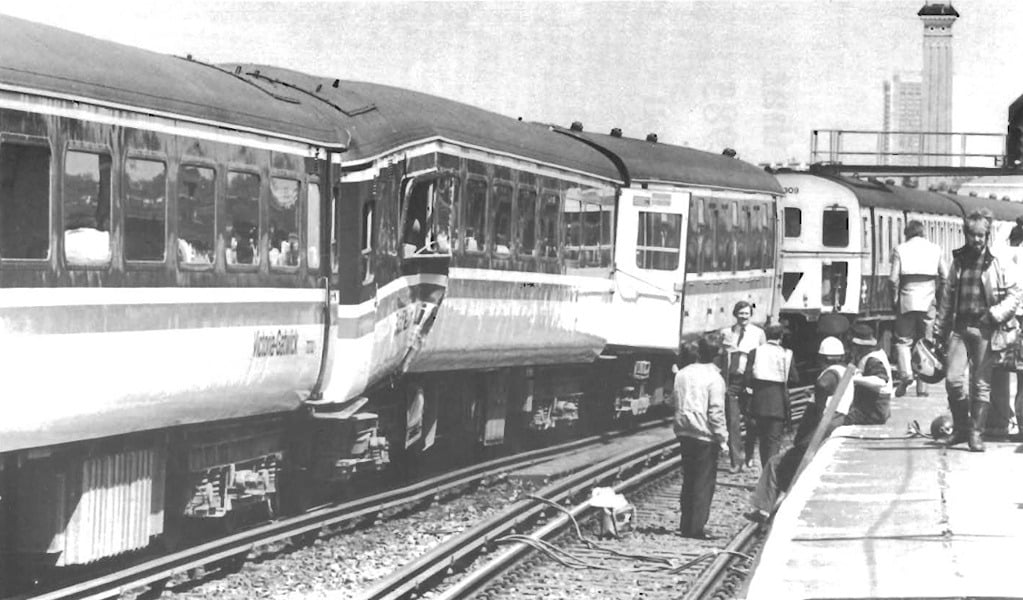
On this day in 1985, a serious railway collision at Battersea Park station in south London injured more than 100 people after a Gatwick Express service ran into the rear of another passenger train. The crash happened on 31 May 1985 on the busy approaches to London Victoria, one of the capital’s most important railway termini. Although no one was killed, the accident caused significant injuries, damaged both trains and led to a Department of Transport investigation into how two passenger services came to be in the same section of line.
The first train involved was the 08.51 East Grinstead to Victoria passenger service, formed of two three-car diesel-electric multiple units. It had been held at a signal and was accelerating away when it was struck from behind by the 09.20 Gatwick Airport to Victoria service. The second train was a Gatwick Express, formed of a motor luggage van, eight passenger vehicles and an electro-diesel locomotive at the rear. Both trains were heavily loaded, with many passengers on the airport service being overseas visitors arriving into London.
The Gatwick Express had passed signal VC564 at danger, a signal that should have protected the train ahead from a rear-end collision. The official report found that the accident was entirely due to Driver Short allowing himself to be distracted from his duties for a few seconds. During that time, he cancelled the Automatic Warning System alert for the signal and allowed his train to continue past it while it was showing danger. The report also stated that there were no contributory defects on the train or in the signalling equipment, both of which had performed as designed.
The collision took place in fine, sunny conditions, with the closing speed between the two trains estimated at about 20mph at the moment of impact. Neither train was derailed, but every vehicle sustained some form of damage. Most of that damage did not seriously affect the passenger accommodation, although one coach was more badly affected than the others. Even without a derailment, the sudden rear-end impact was enough to throw passengers about and cause a major emergency on a busy section of railway close to Victoria.
In total, 104 people were taken to hospital after the crash, with 18 detained for further treatment. The most seriously injured passenger remained in hospital for 14 days before being released. The figures underline how dangerous a collision can be even when the trains remain upright and the impact speed is not exceptionally high. For passengers expecting a routine arrival in London, the crash was a sudden and frightening reminder of how quickly a momentary lapse could lead to serious consequences on a crowded railway.
Remembered today, 41 years on, the Battersea Park crash remains a significant British Rail-era accident because it exposed the consequences of a critical failure in signal observance rather than a mechanical or signalling defect. The report’s conclusion was clear, but it also noted that Driver Short freely admitted his error without claiming any mitigating circumstances. The events of 31 May 1985 showed why railway safety depends not only on equipment performing correctly, but also on drivers remaining alert to the warnings and signals that protect every train around them.
Image: Department for Transport
Related Stories