How Lumo Became Britain’s Budget Rail Disruptor

Lumo is one of the most distinctive train operators on Britain’s railway, not because it runs the largest network or serves the most stations, but because of what it represents. Launched in 2021, the FirstGroup-owned operator set out to prove that a leaner, cheaper, open-access model could work on one of the country’s most important inter-city corridors. Its original service between London King’s Cross and Edinburgh Waverley was designed around a simple idea: lower fares, one class of travel, digital booking and a direct challenge to both existing rail competition and domestic aviation.
The operator arrived at a time when the railway was still dealing with the after-effects of the pandemic, changed commuting patterns and a wider debate about the future structure of passenger rail. Lumo was not a conventional franchise or government-contracted operator. It was an open-access business, meaning it applied for the right to run services over the national network and took on the commercial risk of doing so. That distinction matters, because Lumo’s success or failure depends far more directly on whether it can attract enough passengers to cover its costs.
Its original East Coast operation was deliberately focused. Rather than trying to be all things to all passengers, Lumo concentrated on the long-distance flow between London, the North East and Scotland. The core route linked London King’s Cross with Edinburgh, with regular intermediate calls including Newcastle and Morpeth, and some services also calling at Stevenage. It was a route already served by LNER, but Lumo’s pitch was different. It was not selling first class, fine dining or a traditional inter-city premium offer. It was selling a simpler alternative: book early, travel affordably, and use rail rather than flying.
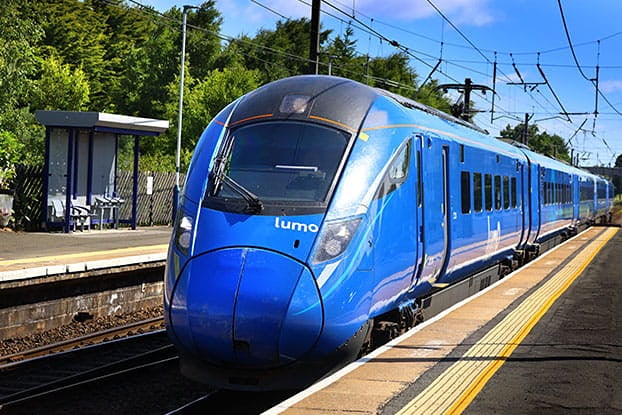
That air-versus-rail argument became central to Lumo’s identity. The London to Edinburgh market has long been one of Britain’s key domestic air corridors, with frequent flights competing against rail journeys on the East Coast Main Line. Lumo positioned itself as a greener alternative, helped by the fact that its East Coast service uses Hitachi Class 803 electric trains. These five-car units are closely related to the wider AT300 family used elsewhere in Britain, but the Class 803s were built specifically for Lumo’s open-access operation. The all-electric East Coast fleet gave the company a strong environmental message from the start.
Inside, Lumo also took a different approach. The trains were arranged as a single-class service, avoiding the split between first and standard class. That helped support the low-cost message and gave the operator a clearer identity. There were no complicated layers of onboard offer, and the branding leaned heavily on simplicity. For some passengers, that made Lumo feel like a rail equivalent of the budget airline idea, though with the advantage of city-centre stations and without the airport security queues or transfer times that come with flying.
The comparison with aviation is useful, but it can also be misleading. Lumo does not operate in a free and open sky. It runs on a busy railway where paths, capacity and performance all have to be balanced against existing operators and freight. The East Coast Main Line is one of Britain’s most important mixed-use rail corridors, carrying long-distance passenger trains, commuter services, regional trains and freight. Giving a new operator space on that network is not as simple as adding another departure to a board. It requires regulatory approval and careful consideration of whether extra trains can be accommodated without damaging performance elsewhere.
That is where open access becomes controversial. Supporters argue that operators such as Lumo increase passenger choice, stimulate demand and put pressure on fares. They point to markets where new services appear to have attracted people who might otherwise have flown, driven or not travelled at all. Critics argue that open-access operators can concentrate on commercially attractive routes while publicly contracted operators retain broader obligations. In simple terms, the debate is about whether open access grows the railway or cherry-picks the best parts of it.
For passengers, the appeal is easy to understand. Long-distance rail in Britain can be expensive, especially for those booking late or travelling at popular times. Lumo’s cheaper fares helped it stand out, and its existence added another option on a route where many travellers already compare train and plane prices. Even where passengers never use Lumo, the presence of another operator contributes to the sense that rail can be more flexible than the old model suggested. The company’s great strength has been its ability to make a long-distance inter-city train feel simple and accessible.
Its limitations are just as important. Lumo’s model relies on a limited fleet, specific routes and efficient use of train paths. It does not have the scale or flexibility of a larger operator with a wider network and more rolling stock. When things go wrong, smaller open-access operations can have less spare capacity to absorb disruption. A limited-stop service can also be very useful for some passengers while doing little for others along the same route. The very focus that makes Lumo commercially sharp also means it is not a universal solution to Britain’s rail problems.
The next stage of Lumo’s story has made the brand more complicated. In 2026, Lumo expanded beyond its original East Coast operation with a West Coast route linking London Euston and Stirling. This brought the company into a different market, serving places including Milton Keynes, Nuneaton, Crewe, Preston, Carlisle, Lockerbie, Motherwell, Whifflet, Greenfaulds and Larbert. It also moved Lumo beyond the simplicity of being known purely as an all-electric East Coast operator.
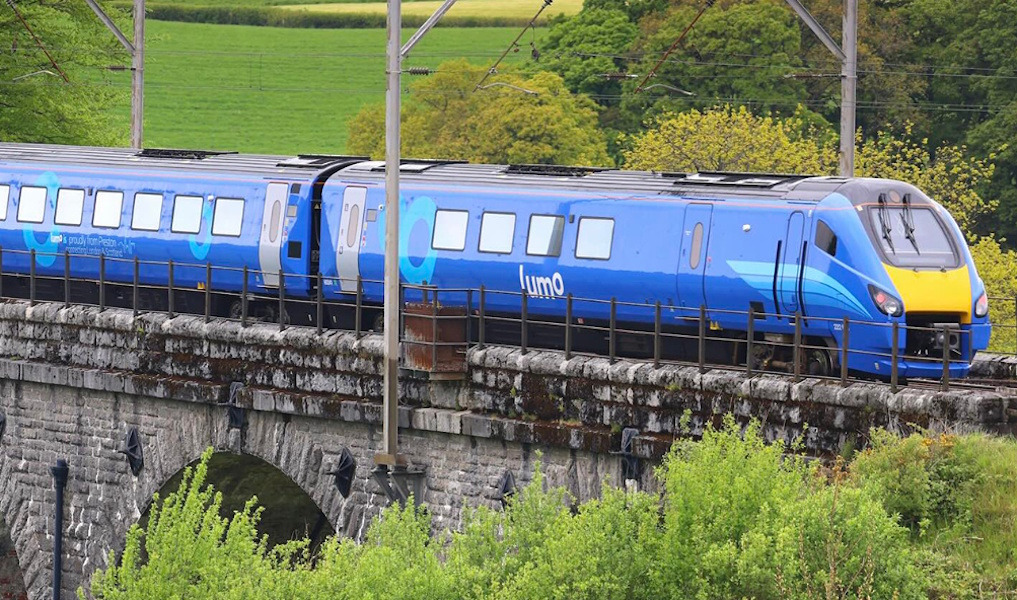
The reason is the rolling stock. The West Coast service is planned around refurbished Class 222 trains, a diesel multiple unit type previously associated with East Midlands inter-city services. That does not erase the environmental case made for Lumo’s original electric trains, but it does complicate the wider branding. A company that built much of its identity around all-electric operation on the East Coast now has a broader operation that includes diesel traction. For a brand so closely tied to sustainability, that distinction matters and needs to be understood clearly.
There is still a practical argument for the West Coast expansion. New direct links can be valuable, especially for places that gain through services to London or Scotland without relying on multiple changes. Open access often looks for precisely those gaps: flows where the operator believes there is unmet demand and where a commercially viable service can be created. The Stirling route gives Lumo a chance to prove that its model can work away from the East Coast Main Line and in a more complex operating environment.
Lumo’s importance, then, is not just in the trains it runs. It is in the pressure it applies to assumptions about what inter-city rail has to look like. It has challenged the idea that long-distance rail must always be expensive, complicated or aimed mainly at business travellers. It has also highlighted the difficult balance between competition, capacity and public-service obligations on a railway that is already busy. For supporters, Lumo is proof that rail can win new passengers when it is simple and affordable. For sceptics, it is a reminder that not every good-looking commercial opportunity solves the wider network’s problems.
As a Railway in Focus subject, Lumo is still a story being written. It is modern, ambitious and commercially bold, but it is also a test case for how far open access should go on Britain’s railway. Its East Coast service gave the brand credibility, while the West Coast expansion has broadened both its reach and the questions around it. Whether Lumo becomes a template for future long-distance competition or remains a distinctive exception, it has already made the railway harder to discuss without mentioning open access, low fares and the fight to win passengers back to rail.
Related Stories